The Camera Acquisition That Tells Us What OpenAI Is Really Building
Buying Glass Imaging is less about better photos than owning the hardware layer where an AI assistant becomes useful.
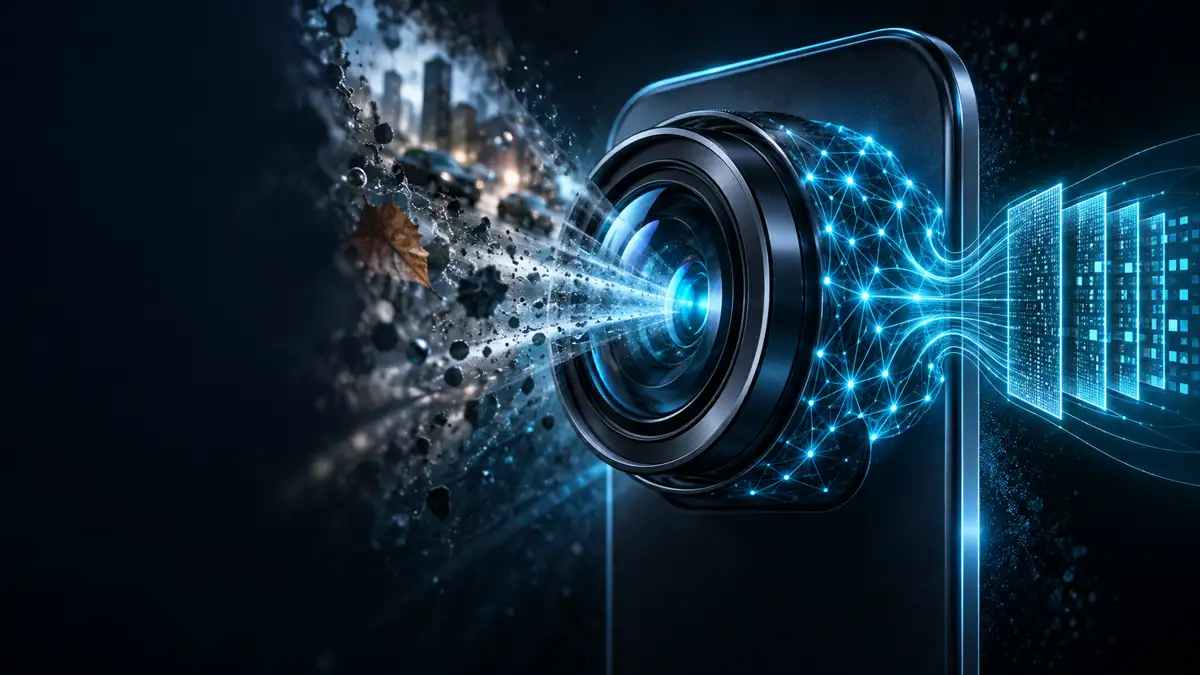
OpenAI buying Glass Imaging for more than $300 million is easy to file under “AI company buys hardware startup.” I think that misses the interesting part.
Glass Imaging is a small Los Altos company founded in 2019 by Ziv Attar and Tom Bishop, two former Apple engineers who led the team behind Portrait Mode. Its approach was not to slap a generative filter on a finished photo. The company trained neural networks around the characteristics of individual camera systems, using software to compensate for the physical limits of a phone lens and sensor.
That is a very particular capability. It sits close to the moment when a device senses the world, before an assistant can reason about it, search it, or act on it. OpenAI appears to be buying that boundary.
The important distinction is where the AI runs
Most people experience computational photography as editing: remove an object, brighten a face, blur a background, generate a missing patch of sky. Glass Imaging’s reported approach is earlier in the pipeline. The model learns the quirks of a camera system and helps produce a better image at capture time.
For an AI device, that matters. A camera is not just a sensor that produces a JPEG for a gallery app. It is a continuous input channel. It can tell an assistant what is on a desk, which sign you are looking at, whether a machine part is damaged, or what changed since yesterday. The quality of that input sets a ceiling for everything downstream.
A blurry or badly exposed frame creates an inference problem. The model has to guess whether a dark shape is a cable, a crack, or a shadow. Better capture reduces that uncertainty before the language model gets involved. It is the same reason infrastructure engineers care about telemetry quality before they tune an alerting system. Garbage in is not a philosophical problem. It is an operational cost.
This is also a manufacturing strategy
The Hacker News discussion focused on a second possibility: software could let a new company avoid some of the hardware complexity that made earlier smartphone challengers fail. That idea is plausible, but it has limits.
If software can make a small sensor behave more like a larger one, a device maker may have more freedom in industrial design. It could reduce the need for a camera bump, choose cheaper components, or build a product around a different physical form. The company would be shifting some complexity from the factory into models, calibration, and compute.
That trade is familiar to software people. You replace a fixed hardware capability with a system that needs data, tests, runtime budgets, and constant maintenance. The bill does not disappear. It moves.
The practical constraint is latency and power. A camera pipeline that runs a neural network at capture time has to work on a battery, under thermal limits, without making the shutter feel broken. It also has to behave consistently across lighting conditions and device generations. A demo can hide those details. A product cannot.
The acquisition buys a team as much as a technique
Glass Imaging had raised about $30 million before the reported acquisition. The purchase price, more than ten times that amount, is unlikely to be explained by a commodity image-processing library alone.
The founders’ background is a clue. Building Portrait Mode at Apple required an understanding of optics, sensors, depth estimation, image pipelines, and the ugly edge cases that appear when real people take photos in bad light. That knowledge is difficult to recreate by hiring a general computer-vision team after the fact.
OpenAI already has access to models and infrastructure. What it has less of is accumulated experience shipping a camera system inside a consumer product. The acquisition shortens that learning curve.
This resembles the earlier io deal with Jony Ive, which TechCrunch reported at $6.5 billion in 2025. In both cases, OpenAI is adding people who understand the physical product layer, not just the model layer. The pattern matters more than any individual press release.
The hard problem is still the product ecosystem
A great camera does not make a phone successful. The HN comments returned repeatedly to the problem that killed many mobile platforms: users need banking apps, ride-hailing, MFA, messaging, enterprise management, and reliable support. Developers do not build for a platform without users, and users do not switch to a platform without apps.
Agents change the shape of that problem, but they do not magically remove it. An assistant might generate an interface for a service, call an API, or work through a browser. That only works while the service exposes stable interfaces and accepts the security and support consequences. If every customer is running a slightly different generated client, debugging becomes somebody’s problem. Usually it becomes the service provider’s problem, which gives that provider a reason to close the door.
The less speculative path is an AI device that complements the existing phone rather than replacing iOS or Android immediately. Better sensing, better context, and a smaller number of carefully controlled interactions can create value without asking users to abandon their app ecosystem on day one.
That is where the Glass acquisition looks most rational. OpenAI does not need to win the smartphone market first. It needs to make a device understand the user’s environment better than a generic phone can. The camera is one of the few sensors that can provide that context at useful scale.
What I would watch next
I would not treat this acquisition as proof that an OpenAI phone is imminent. The article itself only says the company is rumored to be working on phones, earbuds, and companion devices. There is no product announcement here, and OpenAI had not commented when TechCrunch published the report.
I would watch for three concrete signals instead. First, whether OpenAI hires or acquires more people from optical, audio, and low-power systems backgrounds. Second, whether its device work emphasizes ambient context rather than a standalone chatbot screen. Third, whether the company talks about local processing, data retention, and user control with the same precision it uses to describe model capability.
The camera is an intimate sensor. If it becomes the front door for an AI assistant, trust and control are product requirements, not legal copy at the bottom of a settings page.
My read is simple: OpenAI is trying to own the input layer, not just the response layer. Glass Imaging gives it a team that knows how to turn imperfect physical signals into usable machine perception. That could make future hardware feel smarter. It could also make the privacy and reliability questions much harder to ignore.
Source: OpenAI buys smartphone camera maker Glass Imaging for $300 million, report says